
Most Minecraft servers have an online store on their website. You open it, you see crates and ranks, you pay, and that is it. The money goes to the owner. The items stay in the game. When you leave, what you bought stays behind.
That is how it has worked for 16 years in Minecraft servers, and most video games.
That model is a net negative for society. We want to end it.
The gaming industry decided players should generate value but never capture it. That is the most obvious broken system nobody is fixing, and whoever fixes it defines the next step of humanity inside virtual worlds.
On MineX, the store works in a way most players have never seen before. When you go to scan.minex.gg/store and buy a crate, you are not buying from us. You are buying from another player who earned it by playing. They listed it. You bought it with your card or with USDC. The money went directly to them.
We built the roads, the market, and the whole economy underneath it. This is already live and players love it. Here is a look under the hood at how it actually functions.
Three Layers
To understand how this works, you need to understand how the economy is structured in MineX, and in other Minecraft servers. There are three layers.
The first is the soft currency, money. The basic in-game money, easy to earn, used for everyday things on the server.
The second is shards. This is the hard one. Premium currency takes real time and effort to accumulate. It is what serious players grind for. And it is what you need to buy the items that actually matter, like crates and protection blocks.
This system of soft currency and premium currency is common across video games. Fortnite has it. Many multiplayer games use it.
The third layer is where we are different. Real money. In-game it just shows up as USD, and most players never realize what is behind it. It is actually USDC on Solana, sitting in their own non-custodial wallet created for them with MetaKeep. They control it, and we cannot touch it. You can see your balance in-game like any other currency.
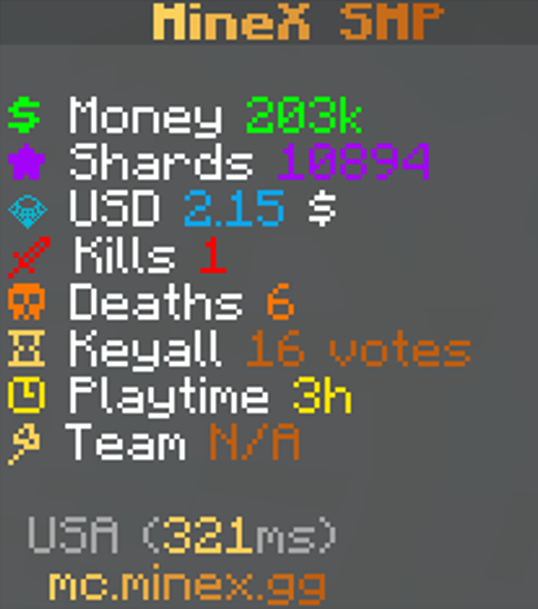
Most games stop at layer one or two. We built all three, and then connected them.
The Market
A player needs to spend several weeks on the server to accumulate enough shards to buy a high-tier crate. That crate holds real value. It can be sold for real USDC. So instead of opening it, they can list it on our marketplace for real money.
For the buyer, nothing changes. A player who just discovered MineX and wants to progress faster goes to the store, exactly like on any other server they have played. Click buy. Enter username. Pay with their card. The crate lands in their inventory instantly. They will never notice the difference. But behind those three clicks, everything is different. Their money went to a real person, not a corporation.
The seller gets paid in USDC, directly to their wallet.
| Platform | Fee on a player sale | Seller keeps |
|---|---|---|
| MineX (player-to-player item trades) | 10% | 90% |
| MineX (fixed-price crates) | 30% | 70% |
| CS:GO | 15% | 85% |
| Roblox | 70% | 30% |
On crates specifically, the price is fixed so it is always clear what you are paying. The 30% covers payment processing, blockchain fees, and keeping the server running.
Players already try this on normal servers. They trade in hidden Discords, get scammed, or get banned. Owners forbid it for one reason. They want all the money flowing in one direction. Up.
We are running the opposite experiment, live, right now. An economy where the money flows between players. It is already working.
No Gambling
Most Minecraft crates work like slot machines. You pay, you open, and a small chance decides if you got something good or wasted your money. The odds are usually public, but that does not make it fair. Knowing the exact percentage is part of what keeps people opening. It works very well, especially on young players, and that is exactly why almost every server uses it.
We decided not to.
The problem with loot boxes is not the surprise. It is that you can lose. You pay, and you might get nothing of value. So we designed our crates around one rule: you can never lose an opening.
- Common, Rare and Epic crates have no randomness at all. You see everything inside, you pick the item you want, you get it.
- Legendary and Mythic crates give you the same item no matter how you open them. Same item, same stats, same power. Your only choice is the form. Pick it directly and it becomes soulbound, yours forever but not tradeable. Open it sealed and it comes with a seasonal skin, rotating monthly, which you can trade or sell.
Chance only decides what your item looks like, never how strong it is. Nobody opens a crate and gets an advantage. Nobody opens a crate and gets nothing.
Some skins will end up rarer and more valuable than others, and collectors will trade them. We believe that is healthy. Collecting is fun. Losing is not.
Ranks: Comfort, Not Power
MineX also has ranks, like almost every Minecraft server. But ours follow the same rule as everything else in our economy: money can never buy power.
A rank does not give you better items. It does not make you grind faster. It will never help you win a fight.
What it gives you is comfort. More homes to teleport to. More listings on the market at once. Cosmetic effects, prefixes, the small things that make daily life on the server nicer.
A player with no rank and a player with the highest rank meet in a fight as equals.
Why Only Minecraft
You cannot build this in other games.
In Fortnite, in Roblox, in any game owned by a studio, you do not control the payments. You cannot self-host. You are never the owner of your own game. They can shut you down anytime, without warning and without justification, and everything you built disappears with one email. Most of the time, not even an email.
Minecraft is one of the few games on Earth where you can choose to build an independent economy. Your own servers, your own payments, total freedom. And it happens to be the most sold game in history, over 300 million copies. That is why we have spent five years building crypto servers here, and nowhere else.
We are not building a new game from zero like most crypto projects do, burning insane amounts of money to attract players that never come. We are building on the game players already love.
Infrastructure, Not Just a Server
Our API is now the core of the economy. Every trade, every wallet, every item on chain. We own the whole stack, end to end. We wrote about how we got there here.
The plan is not only to keep growing our own servers. Other Minecraft servers can use the same infrastructure. Other games too. We are already exploring it.
In a traditional server, the owner sits at the top of a pyramid and everyone else feeds it. On MineX, the structure is a network. Players trade with players. Value moves between them. We build and maintain the roads, and take a small fee for doing so.
That is what a real economy looks like.
Most players leave their worlds with nothing behind.
On MineX, you don't have to.
Originally published on X, August 17, 2026 by Yeray Selva Vallejo, Founder and CEO of MineX.